Over 90% of aspiring authors never finish their first draft. I used to be one of them – and honestly, I thought flour-dusted hands were my excuse.
For years, I told myself the same story: I’d write my romance novel someday. Someday, when the cupcake orders slowed down. Someday, when I wasn’t elbow-deep in buttercream at 11pm. Someday never came.
Romance is the highest-selling fiction genre in the world right now. Millions of readers are devouring love stories faster than authors can write them. And I had a story I genuinely believed in – a second-chance romance called Sugar & Second Chances, about a woman named Nora Bellamy who returns to her seaside hometown to save her grandmother’s cupcake shop, only to find herself face-to-face with the developer trying to tear it down: Daniel Hart, her high school rival and the boy who broke her heart.
A bakery. A beach town. An enemies-to-lovers slow burn.
It had everything. Except, apparently, a finished draft.
Writer’s block is real. So is a 5am baking schedule.
Then I stumbled across BookNova, an AI novel generator that claims to take a story idea and produce a full, publish-ready novel in 30 to 90 minutes. My first reaction was pure skepticism. My second reaction was: well, my cupcakes need 25 minutes in the oven anyway.
So I tried it. I dropped in my premise, my characters, my messy seaside setting – and I watched something I’d been putting off for three years start to take shape between batches.
This article is my honest account of that experience. I cover everything I discovered along the way:
- Why my dream of writing a romance novel kept stalling – and what actually changed
- How BookNova turned my story spark into a full plot in minutes
- Whether the characters and dialogue felt real, or robotic
- The cover art and marketing materials the platform generated (this part genuinely surprised me)
- Who this tool is actually right for – and where to go in with realistic expectations
I’m not a professional author. I’m a home baker with a dream and a very limited window between proving dough and decorating birthday orders. If that sounds like you, keep reading.
Starting a novel doesn’t have to feel like climbing a mountain in the dark. Sometimes it just takes finding the right tool – and a free half-hour while your cupcakes cool.
For years, the idea of writing a romance novel lived rent-free in my head, somewhere between my grandmother’s buttercream recipe and my ever-growing list of things I’d get to “someday.” I had the feelings, I had the daydreams – I even had a story brewing about a woman returning home to save a beloved cupcake shop and facing the boy who once broke her heart – but turning that into an actual manuscript felt impossibly out of reach. Here, I want to be honest about why that dream kept stalling, and what finally made me take it seriously.
Why I Wanted to Write a Love Story
Romance isn’t just the biggest-selling fiction genre on the planet – it’s the one that makes you feel something. In 2023, romance readers spent $1.44 billion on books. That number stopped me mid-frosting one afternoon. That’s not a niche hobby. That’s a hunger.
I’ve been reading romance novels since I was sneaking them off my mum’s bookshelf at fourteen. There’s something about a love story that no other genre quite replicates – that specific tension of two people circling each other, both too stubborn or too scared to close the gap.
My absolute favourite trope? Enemies-to-lovers. Every time. Give me two people with history, with grievances, with a reason to stay apart – and then watch them fall anyway. I’ve read that setup a hundred times and I still hold my breath at the moment it cracks.
65% of romance readers say character-driven stories matter more to them than plot – which means the emotional truth of your characters is the whole job, not a bonus.
That statistic – 65% of romance readers preferring character-driven stories over plot – is the one that made me believe I could actually do this. I’m not a plot architect. I don’t think in twists and timelines.
But I do think in people. I know what it feels like to carry an old grudge into a room and pretend it isn’t there.
I had a story in my head for years. A woman coming back to a seaside town to save her grandmother’s cupcake shop, only to find the developer threatening to buy it out is the boy who broke her heart at the summer fair. Small town romance, enemies-to-lovers, a grandmother’s recipe box holding the whole thing together.
I could see Nora. I could hear Daniel.
I just couldn’t find the time to write them.
Romance offers something I think a lot of us are quietly starving for – the permission to believe things work out. Not naively. Not without cost.
But eventually, beautifully, deservedly. Writing that felt like the most worthwhile thing I could do with a free afternoon.
The problem was, free afternoons don’t exist when you’re running a home bakery. Between early-morning dough prep, custom order deadlines, and the very real possibility of a buttercream disaster at any given moment, sitting down to write felt less like a creative act and more like a luxury I couldn’t justify. The story stayed exactly where it had always lived – in my head, half-formed, waiting.
Juggling Cupcakes and Character Arcs
Finding time to write a novel when you spend 8 to 10 hours a day in a kitchen is not a scheduling problem – it’s a physics problem. There are only so many hours, and flour-covered hands are not great for typing.
My days start before sunrise. Dough needs proofing, buttercream needs whipping, and the oven runs almost non-stop until mid-afternoon. By the time the last tray cools and the kitchen is wiped down, my creative energy is basically a flat-line.
I kept a notebook on the counter for a while. The idea was to jot down scenes during quiet moments – a paragraph here, a bit of dialogue there. In practice, I wrote maybe three sentences before something beeped, bubbled over, or needed my full attention again.
The Gap Between “I’ll Write Tonight” and Actually Writing
Evening was supposed to be my writing time. I’d sit down with Nora Bellamy half-formed in my head – her grandmother’s cupcake shop, the seaside town, the infuriating Daniel Hart – and I’d stare at a blank document for twenty minutes before giving up.
Writer’s block after a long physical day hits differently. It’s not just a lack of ideas. It’s a kind of mental fog where even forming a sentence feels like lifting something heavy.
70% of aspiring writers say time is the main reason they never finish a novel. I used to think that statistic was about laziness. After a year of trying to squeeze writing into the margins of my baking schedule, I completely changed my mind.
The average first novel takes one to two years to write. For someone working a full day job – or, in my case, a full-day kitchen – that timeline stretches even further because the writing sessions are so fragmented. A stolen half-hour on a Tuesday doesn’t connect naturally to a stolen half-hour the following Sunday.
I started wondering whether there was a faster way to get a complete draft onto the page – something that could handle the structural heavy lifting so I wasn’t rebuilding the story from scratch every session.
Nora’s story deserved better than a handful of disconnected paragraphs saved in a document called novel_attempt_4_FINAL_v2.docx. And honestly, so did I.
The romance I had in my head – the slow-burn tension, the rival turned love interest, the whole seaside backdrop – needed a proper three-act shape, character arcs that actually paid off, and scenes that connected. Building all of that in stolen minutes between batches of lemon drizzle cupcakes was, I finally admitted, not going to happen the traditional way.
Getting started with a new piece of writing has always been the hardest part for me – I’d stare at a blank document, second-guess my premise, and eventually wander back to the kitchen to stress-bake another batch of lemon drizzle cupcakes. With BookNova, I wanted to see whether the setup process felt genuinely welcoming or quietly overwhelming. What I discovered, from the moment I typed in my idea for Sugar & Second Chances, surprised me in the best possible way.
From Story Spark to Full Plot in Minutes
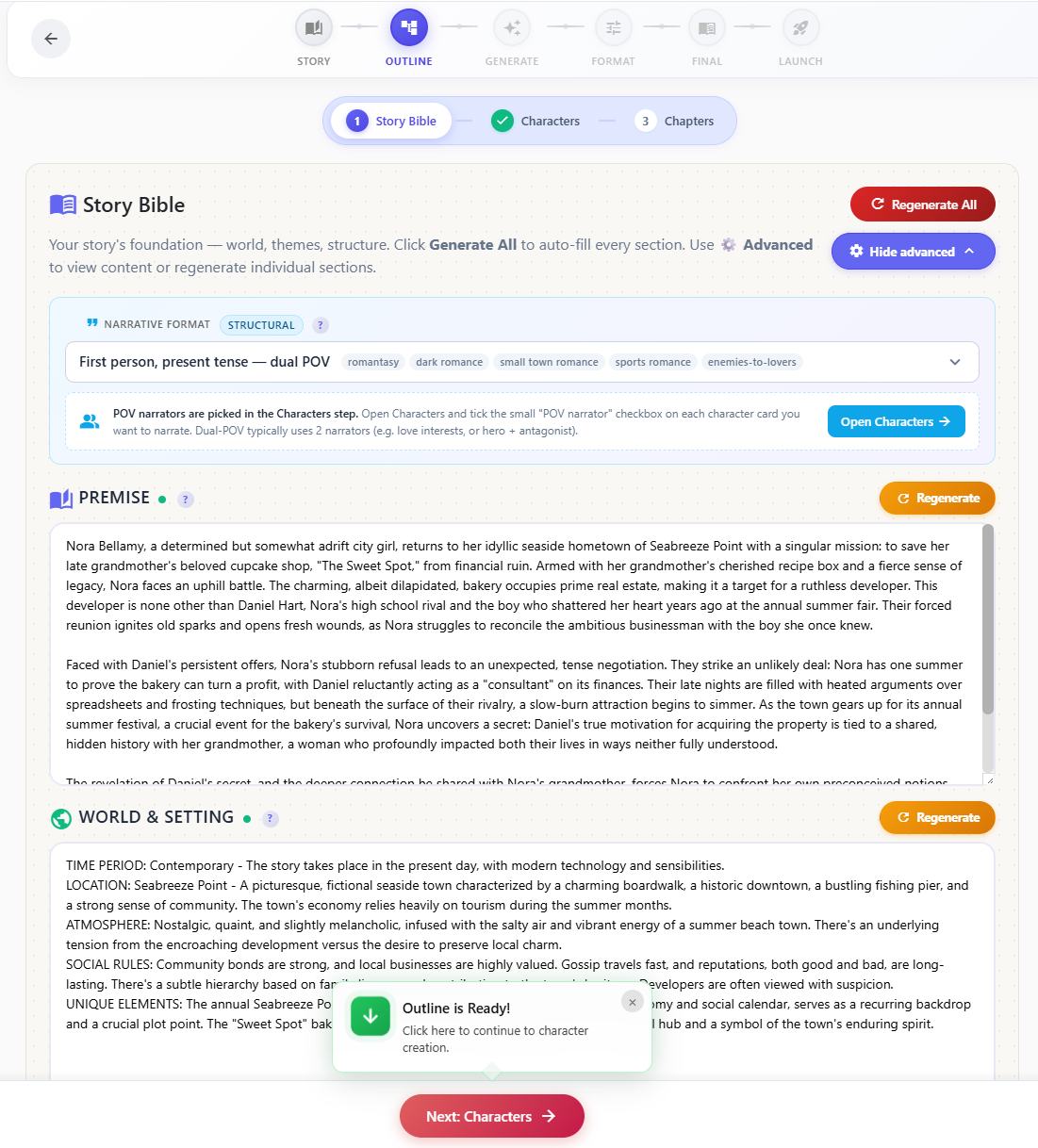
I typed in my premise for Sugar & Second Chances – Nora returning to Seabreeze Point, the crumbling cupcake shop, the developer who broke her heart at the summer fair. Forty seconds later, BookNova had a full plot structure on my screen. Not bullet points. An actual mapped narrative with a clear inciting incident, rising tension beats, a midpoint twist, and a resolution.
That first look genuinely stopped me mid-breath.
What the Three-Act Structure Actually Looked Like
The platform didn’t just label three acts and call it done. It placed genre-specific romance beats inside each act automatically – the first charged confrontation between Nora and Daniel, the forced cooperation that chips at old resentment, the moment the attraction becomes undeniable, the black moment where everything falls apart before the ending.
Romance readers expect those cycles of tension and release. Getting them in the wrong order, or skipping one entirely, is the fastest way to lose your audience. BookNova bakes those conventions in by default, which is dead simple compared to trying to reverse-engineer them from a craft book at midnight.
BookNova generates a full structure fast, but spend two minutes reviewing the plot beats before you proceed – a single vague character motivation in the setup will echo through every chapter the Story Thread Engine builds from it.
The Story Thread Engine is what separates this from any other AI writing tool I’ve tried. My continuity problem – the one where I’d forget what I’d established three scenes ago – is the exact problem it was built to solve. It tracks every subplot, every character detail, every piece of foreshadowing across the entire novel, so a detail planted in chapter three can pay off in chapter fifteen without me keeping a spreadsheet.
For Sugar & Second Chances, that meant the engine tracked Daniel’s dual identity as both the developer and Nora’s past, the financial stakes of the bakery, and the slow thaw of their rivalry – all simultaneously, all consistent.
- Full plot beats, scenes, and dialogue generated from a single premise
- Three-act structure with romance tension cycles placed correctly
- Story Thread Engine maintains character consistency and subplot continuity
- Foreshadowing planted early and honoured later – automatically
- Complete novel process runs 30–90 minutes start to finish
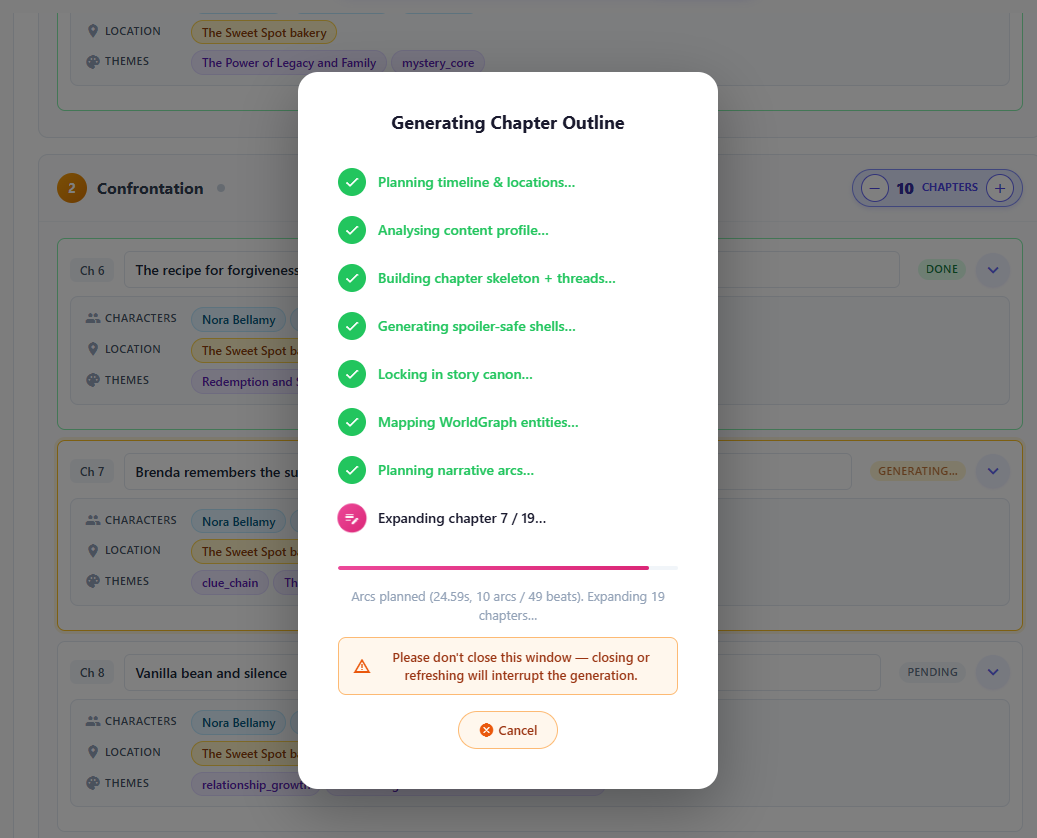
I watched the chapter framework begin to populate – each entry a small promise of actual scenes, actual dialogue, actual pages – and felt something I hadn’t expected: the specific excitement of a project that might actually get finished.
The structure was there. What I still needed to decide was exactly what kind of romance story I was writing, because BookNova’s genre settings go far deeper than just “contemporary romance.”
Picking My Perfect Romance Vibe
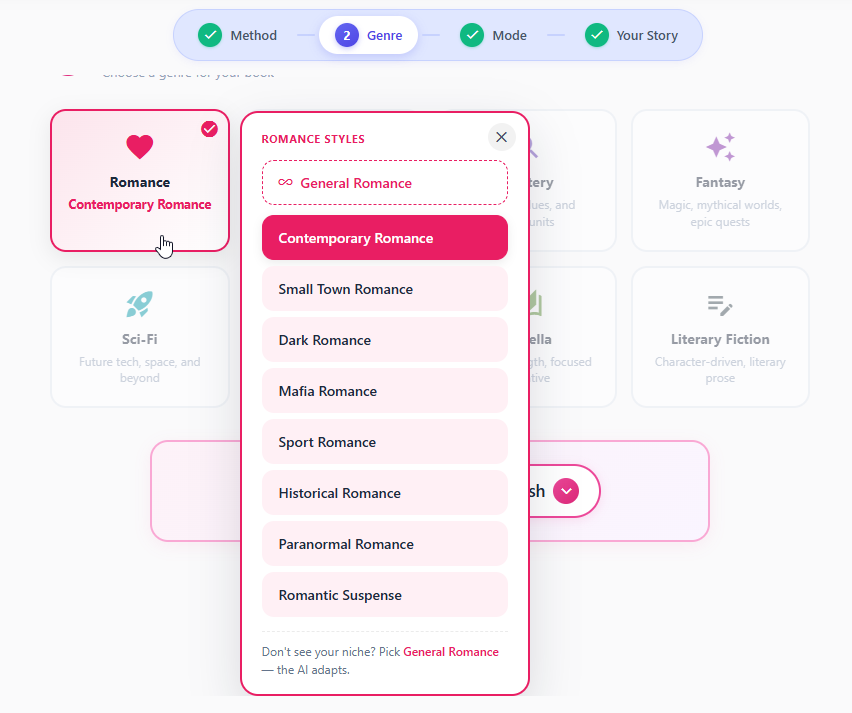
After the plot came together so quickly (still a little stunned by that, honestly), I expected the style settings to be where things got complicated. They weren’t.
Choosing the Genre
BookNova supports core genres – Romance, Thriller, Fantasy, Mystery, and more – plus specific subgenres like Dark Romance, Historical Romance, and Cozy Mystery. I went straight for Contemporary Romance, because that’s where my heart lives. No dragons, no corsets – just two people with history, a seaside town, and a cupcake shop caught in the middle.
What I didn’t expect was how much the AI already understood about the genre. I didn’t have to explain enemies-to-lovers tension or the slow-burn structure. The platform already knows the beats – the push-pull, the almost-kiss that doesn’t land, the moment everything cracks open. It treats those conventions as a given, not as something you have to teach it from scratch.
Picking the POV
This is where I spent the most time, and I don’t regret a single minute of it. BookNova offers 10 POV styles, which sounds overwhelming until you realize they’re organized around real publishing formats you already recognize.
- First Person, Present – Single POV: the Hunger Games format, immediate and in-the-moment
- Third Person, Past – Multi POV: the Game of Thrones format, sweeping and layered
- First Person, Present – Dual POV: alternating hero and heroine chapters – the BookTok bestseller format
- Seven more options beyond those, including a fully custom hybrid if you want something experimental
I picked First Person, Present – Dual POV without much deliberation. For a story like “Sugar & Second Chances” – where both Nora and Daniel are carrying completely different versions of what happened between them – you need to be inside both heads. That format was built for exactly this kind of tension.
Pro Tip: If you write romantasy or dark romance, the Dual POV format is practically the default in that space right now. BookNova flags it as the BookTok bestseller format for a reason – readers in those communities actively seek it out.
Customizing character voices came next, and that part felt surprisingly personal. I gave Nora a stubborn, slightly guarded inner voice – someone who jokes when she’s scared. Daniel got something more restrained, careful with words in a way that reads as cold until you realize it’s just armor. The AI took those notes and ran.
Setting the genre and POV took me maybe ten minutes total. Less time than it takes my croissant dough to proof. And the choices I made in those ten minutes shaped everything the AI produced afterward – which made me genuinely curious what it would do when it sat down to actually write the first chapter.
Once BookNova had Nora, Daniel, and the crumbling sweetness of The Sweet Spot all mapped out, my real worry kicked in – would the actual writing feel flat and mechanical? I’ve read enough AI-generated text to know that soulless prose is a genuine risk, and a romance novel lives or dies on the warmth of its words. What I discovered when the chapters started generating genuinely surprised me, and I think it will surprise you too – particularly when Nora and Daniel finally share the same room for the first time since that summer fair.
Dialogue That Didn’t Sound Robotic
BookNova’s Voice Engine produces dialogue with genuine subtext – the kind where what characters don’t say carries as much weight as what they do. I was braced for the usual AI output: characters addressing each other by name every other line, speeches that wrapped up too neatly, zero tension beneath the words.
That’s not what I got.
When I fed in the premise for Sugar & Second Chances, the first scene between Nora and Daniel didn’t open with declarations. It opened with interruptions. Deflections.
A loaded pause where Daniel glances at the bakery counter instead of answering her question directly. That pause does more work than a paragraph of narration ever could.
Banter With an Edge
The banter between Nora and Daniel carries power negotiation underneath every exchange. He doesn’t say he wants the property – he compliments the cupcake display while his eyes measure the square footage. She doesn’t say she still has feelings for him – she turns back to the oven a half-second too late.
Romantic tension expressed through blocking and proximity, not declaration. That’s a craft distinction most writing advice books spend whole chapters trying to teach.
BookNova’s Voice Engine specifically suppresses the patterns that give AI dialogue away: no em-dashes scattered everywhere as a substitute for thought, no theatrical lines where characters speak in perfect complete sentences for the audience’s benefit, no “Ah, Nora, I never imagined…” openers.
BookNova’s Voice Engine caps em-dashes at roughly the rate published authors use them – about one per 300 words. Default AI output runs five to eight times higher, which is one of the fastest ways a reader clocks that a book is machine-written.
Each Character Sounds Like Themselves
Nora and Daniel have distinct verbal signatures, not just different opinions. Nora’s dialogue runs shorter, sharper – she interrupts, she redirects, she uses bakery metaphors without realising it. Daniel speaks in longer, measured sentences, the kind of cadence someone develops when they’ve learned to control rooms.
Side characters hold their own too. The local gossip at the harbour spoke in folk similes and half-finished confidences. Nobody sounded like the narrator wearing a different hat.
The emotional conversations hit hardest. A late-night scene where Nora confronts Daniel about the summer fair – the moment that broke them years ago – never once labels the emotion. No “she felt betrayed.” Instead: her hands go still on the mixing bowl, she asks a question she already knows the answer to, and the silence after his response is described through what she does with it, not what she feels.
That’s show, don’t tell at a level I genuinely didn’t expect from an AI tool. I’ve read published romance novels that handle that scene worse.
The Lexical Engine runs quietly underneath all of this too, rotating descriptors and imagery across chapters so the prose never settles into the same grooves – which starts to matter enormously once you’re past chapter five and the story needs to feel alive in more ways than just the conversations between your leads.
Every Chapter Felt Fresh and Engaging
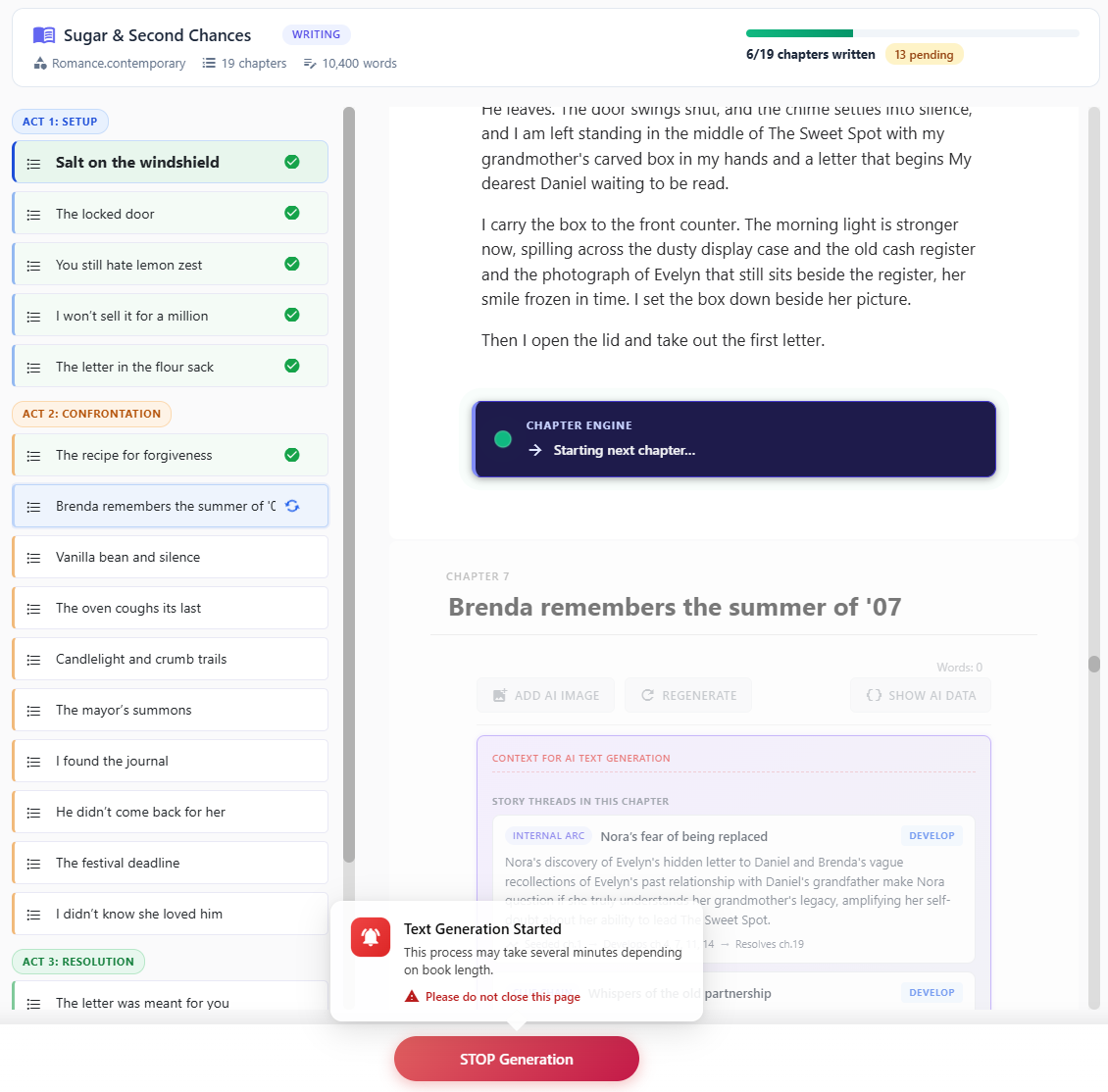
BookNova’s Chapter Craft Engine rotates through 8 distinct opening techniques. Sensory immersion, dialogue cold opens, interior monologue, atmospheric wrongness – the list goes on. Chapter three dropped me straight into the smell of burnt sugar and sea salt before Nora had said a single word. Chapter six opened mid-argument, Daniel’s voice cutting through before I even knew where they were standing.
That’s not an accident. That’s craft.
Endings That Actually Land
The chapter endings surprised me just as much. There are 8 ending techniques in rotation too – emotional beats, dialogue cliffs, singular objects, stated intent. One chapter closed on Nora’s grandmother’s recipe box sitting on the counter, lid still shut.
No explanation. No summary sentence wrapping everything up neatly.
Just that image, sitting there, doing all its work quietly.
I’ve read published romance novels that don’t stick their chapter endings that consistently. And I baked three batches of lemon cupcakes while this was generating.
No Random Jumps, No Lost Threads
Chapter-to-chapter continuity was where I’d expected the whole thing to fall apart. It didn’t. Each chapter picked up from the emotional texture of the one before it – not just the plot summary, but the actual feeling of where the last scene left off.
When Nora and Daniel’s argument ended in chapter seven with her walking away, chapter eight didn’t cheerfully open with her humming while decorating cupcakes. The tension carried.
The engine sees the closing paragraphs of the previous chapter, not just a plot note. That distinction matters more than you’d expect.
Pro Tip: If your chapters keep feeling like disconnected short stories, the problem is usually that your AI tool is working from plot summaries rather than actual prose context. The Chapter Craft Engine reads the real closing lines – which is why the transitions in “Sugar & Second Chances” felt stitched together by hand, not bolted on.
Vocabulary That Didn’t Repeat Itself
Here’s the thing that separates a readable AI novel from an obviously machine-written one: word repetition. The Lexical Engine tracks which descriptors and phrases have been used across recent chapters and actively rotates alternatives. Daniel’s presence wasn’t described the same way twice. The bakery smelled different each time Nora walked in.
Beta readers notice this. Reviewers notice this. Most of them just can’t explain why one book feels richer than another – but this is usually it.
By the time I’d read through the first act of the generated manuscript, I’d also noticed the output included chapter illustrations and a formatted, publish-ready file – which made me realise this thing was building something far more complete than a raw draft.
Varied prose isn’t a bonus feature. It’s the baseline standard BookNova is clearly built around.
Getting the words of Sugar & Second Chances onto the page was one thing, but I genuinely did not expect BookNova to hand me a fully dressed novel ready to meet the world. What came next stopped me mid-batch of lemon cupcakes – a cover that looked like something I’d pull off a bookshop shelf, plus a whole kit of materials I didn’t even know I needed. If you’ve ever wondered what happens after the story is written, this is where the real surprise was waiting for me.
My Book’s Cover Art Blew Me Away
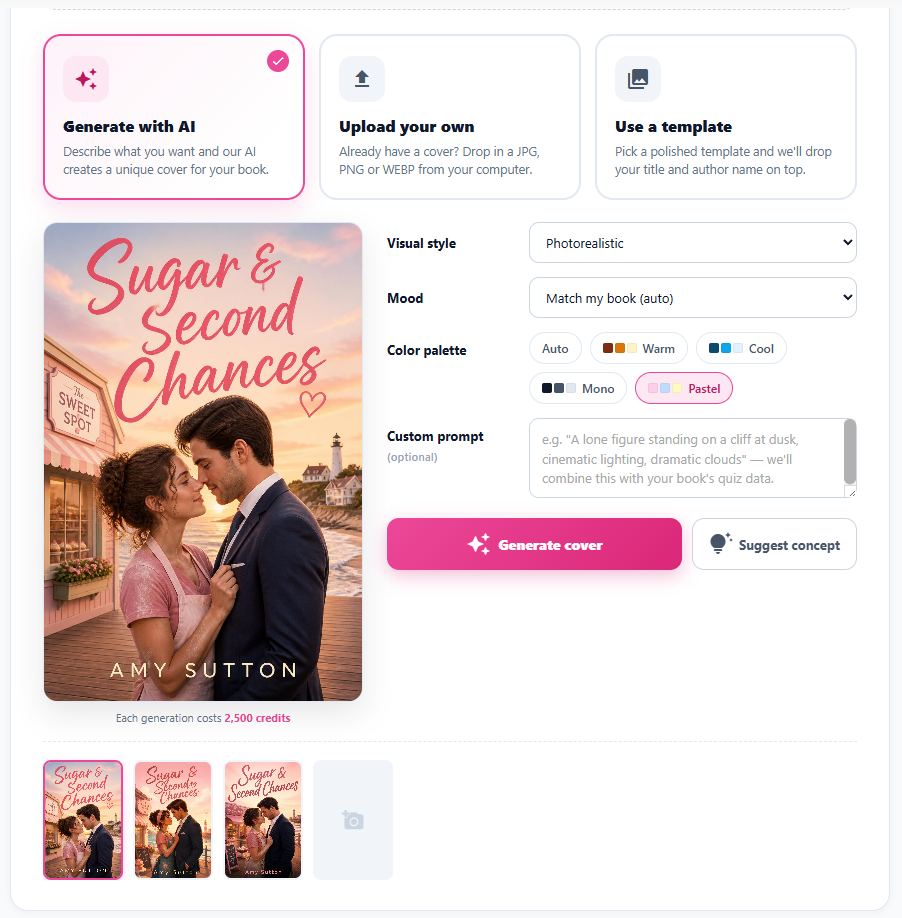
When the cover for Sugar & Second Chances generated, I actually put down my spatula. It captured that warm, bittersweet coastal romance mood perfectly – soft golden light, a seaside backdrop, the kind of image you see on the front table at a bookshop and immediately pick up.
Genre-Aware Means It Actually Knows Romance
This is where I need to explain what genre-aware cover generation means, because it’s not just “pretty picture.” BookNova doesn’t produce a generic illustration and call it a cover. It reads the genre and matches the visual style readers already associate with that type of book.
Dark romance gets moody, shadowy tones. Epic fantasy gets sweeping, dramatic landscapes. My contemporary romance got exactly what it needed – warm, inviting, emotionally charged without being over the top.
A reader browsing Amazon would clock the genre in about two seconds. That matters enormously for actually selling a book, something I’d been quietly thinking about even before the cover appeared.
A cover that doesn’t signal its genre clearly will confuse readers and kill sales before they even read your blurb – genre-matching visuals aren’t decorative, they’re functional.
The Chapter Illustrations Were an Unexpected Gift
I didn’t realise chapter art was included until it appeared. Each chapter opened with a custom illustration styled to match the romance genre – and seeing a visual interpretation of Nora standing outside The Sweet Spot nearly made me cry into my frosting bowl.
The character portraits were equally impressive. Daniel Hart looked exactly as I’d imagined him – that particular mix of polished and guarded that makes a fictional rival so infuriating. Nora had warmth in her expression but steel behind it. These weren’t stock images dropped into a template.
Why This Matters for First-Time Authors
Design is the part that stops most aspiring novelists cold. Hiring a cover designer costs anywhere from $200 to $800. Learning Canva well enough to produce something professional takes weeks. For someone who’s already juggling a bakery schedule and a first draft, that’s a genuine wall.
BookNova removes that wall entirely. The visual assets are generated automatically the moment your book is finished – no separate tool, no separate cost, no separate learning curve.
Seeing Nora and Daniel rendered in actual character art made the whole project feel real in a way the manuscript alone hadn’t. A story on a page is one thing. A story with a cover, chapter art, and character portraits is something you can actually hold up and say: I made this.
And once you have assets that polished sitting in your downloads folder, the question of what to do with them next becomes very hard to ignore.
Ready to Share My Story with the World (and BookTok!)
Writing the book is only half the battle – getting it in front of readers is where most first-time authors completely freeze up. I know because I froze. I had Nora Bellamy’s story sitting on my laptop and absolutely no idea how to tell anyone about it.
That’s where BookNova’s Author Launch Kit changed everything for me. It auto-generates your entire social media marketing package the moment your book is finished. No Canva templates.
No hiring a designer. No staring at a blank caption box at midnight.
Character Cards That Actually Stop the Scroll
BookNova generates 4–6 character cards per book, each sized at 1080×1350px – that vertical format Instagram and BookTok reward in every algorithm update right now. Each card pairs an AI-generated character portrait with personality traits, trope tags, and a real quote pulled directly from the book’s text.
For Sugar & Second Chances, I’d post Daniel Hart’s card first. “Enemies to Lovers” and “Morally Grey” as trope tags, with that line where he tells Nora the bakery is just a building. That single card would spark comment sections faster than any caption I could write myself.
Character cards are the single best way to build anticipation before a book drops. Readers fall for characters before they buy books. That’s just how BookTok works.
Aesthetic Quotes in Two Sizes, Ready to Post
The kit pulls 8–10 of the most emotionally intense lines from your entire manuscript and places them on AI-generated backgrounds that match the book’s mood. You get two formats: 1080×1080px for your Instagram feed and 1080×1920px for Stories and TikTok.
I’d use Nora’s quieter moments – the ones where she’s standing in her grandmother’s empty kitchen, holding that recipe box – for the feed posts. The confrontation scenes with Daniel go straight to Stories, where the tall format hits harder.
Teaser Texts That Do the Heavy Lifting
Five teaser texts come with every book – short 100–200 word excerpts pulled from the highest-tension scenes. The first meeting. The betrayal.
The confrontation. Each one arrives with a hook line already written, ready to drop into a BookTok video overlay, an Instagram caption, or a Goodreads update.
For a romance like Sugar & Second Chances, the scene where Nora realises Daniel is the developer trying to buy The Sweet Spot writes itself as a teaser. The shock, the history, the cupcake batter probably still on her apron. That 150-word excerpt does more promotional work than a polished press release ever could.
Publishing and distribution – the actual moment of putting the book on Amazon KDP or Kobo – becomes a much lighter lift when your marketing is already done before you hit that final export button.
New authors overthink promotion. These three tools – character cards, aesthetic quotes, teaser texts – cover every major platform without requiring any marketing experience at all.
After spending weeks testing BookNova while juggling flour-dusted countertops and the whole emotional rollercoaster of writing “Sugar & Second Chances” – Nora’s fight to save her grandmother’s cupcake shop and her complicated history with Daniel Hart – I’ve formed some pretty clear opinions about who this tool genuinely serves well and who might find it frustrating. My honest take isn’t a simple thumbs up or thumbs down, because the answer really depends on where you’re starting from and what you need. What I can tell you is that understanding both sides before you commit will save you time, money, and a fair amount of confusion.
Why I’d Recommend It for Aspiring Authors
BookNova removes the three barriers that stop most first-time novelists before they ever reach chapter two: not knowing where to start, losing the thread halfway through, and never having a finished, publishable file at the end. After my own chaotic experience writing Sugar & Second Chances between cupcake batches, I can say with confidence that this platform genuinely delivers on all three.
It Solves the Blank Page Problem Directly
Writer’s block isn’t a creativity problem. It’s a structure problem – you don’t know what comes next because nobody mapped the road. BookNova’s AI Story Generation takes your premise (Nora, Daniel, a crumbling cupcake shop, a ruthless developer) and builds the entire plot architecture before a single chapter gets written.
For a first-time novelist, that’s the difference between staring at a cursor and actually writing.
The Story Stays Coherent – All the Way Through
60% of first drafts never become finished novels, and structural collapse is usually why. The Story Thread Engine is the feature I’d point any aspiring author to first. It tracks every subplot, every character detail, every planted foreshadowing beat across the whole book – so Daniel Hart doesn’t mysteriously change personality between chapter four and chapter twelve.
The Chapter Craft Engine handles the sentence-level work: varied chapter openings, varied endings, real continuity between scenes. No five consecutive chapters starting with “the next morning.” That alone makes the output read like a deliberate author wrote it.
You End Up With a Real, Publishable Book
The KDP-Ready Export is something I didn’t fully appreciate until I saw the alternative – spending days formatting a Word document for Amazon. BookNova exports directly to PDF, EPUB, and DOCX with proper drop caps, scene breaks, and margins. One click and the file is ready for Amazon KDP, Kobo, or Apple Books.
For a first novel, that finish line matters enormously. Reaching it builds the confidence to write the next one.
The Pricing Makes Sense for Beginners
- Lite ($59 once) – PDF export, 50,000 credits per month, built for writers finishing their first book
- Pro ($99 once) – PDF, EPUB, and DOCX export, plus the Author Launch Kit with character cards and aesthetic quote graphics
- Platinum ($179 once) – 200,000 credits per month, the same three export formats, ideal if you plan to publish more than one or two books a year
No subscription. No monthly bill. Pay once and the credits refresh every month. For a home baker who wasn’t sure she’d even finish one novel, the Lite tier was a no-risk entry point.
There are situations where BookNova works better for some writers than others – and I’ll get into that – but for anyone staring at a blank document wondering if a first novel is even possible, this platform makes a genuinely strong case that it is.
Things to Consider Before You Dive In
BookNova does the heavy lifting, but it doesn’t do everything. Before you drop your premise about Nora Bellamy and her cupcake shop into the generator, it’s worth understanding a few practical realities that will shape your experience.
The AI Draft Is a Starting Point, Not a Finished Manuscript
Every novel BookNova generates is AI-written – and that means a human editing pass is always recommended before you publish. The prose will be coherent and structured, but your personal voice, the specific emotional beats you imagined for Nora and Daniel’s reunion, those final touches need you.
I noticed this myself. The tool gets the bones right – the tension, the pacing, the tropes – but certain lines felt slightly generic until I went back and made them mine. That editing step isn’t a flaw in the system. It’s just how good writing works, AI-assisted or not.
Skipping that pass is the one thing I’d caution against, especially for a debut novel you want readers to love.
Budget 2–4 hours for a human editing pass after generation – focus on dialogue and emotional beats, which benefit most from a personal touch.
Custom POV Needs Extra Attention for Complex Stories
BookNova offers a Custom POV option – a setting where you describe a non-standard narrative structure, like an epistolary format or a mixed-POV framed narrative. For straightforward romance, the preset options work beautifully.
But complex narrative structures require more refinement. If your story involves layered timelines or an unusual narrator setup, expect to spend more time guiding the AI and reviewing the output carefully. It’s not impossible – just more hands-on.
For a first novel, I’d honestly stick to one of the ten built-in POV styles. That’s a decision you can make in thirty seconds, and it removes a significant source of friction early on – which matters when you’re just starting out and need momentum more than complexity.
Understanding the Credit System
BookNova runs on a monthly credit refresh tied to your plan. The Lite plan refreshes at 50,000 credits per month, Pro at 100,000, and Platinum at 200,000. Credits are the fuel for every generation – chapters, covers, character art, the works.
For a single romance novel, the Lite plan at $59 is genuinely sufficient. Where you might feel the limit is if you want to generate multiple versions of the same chapter, experiment with different tones, or produce a full series within one month.
50,000 credits sounds abstract right now. My practical advice: generate your full novel first, then use remaining credits for the Author Launch Kit assets. Don’t burn credits on restarts before you’ve seen what the first full draft looks like.
When a More Hands-On Approach Still Makes Sense
Some writers genuinely want to craft every sentence themselves – and that’s a valid creative choice. BookNova is built for people who want a complete, structured draft fast, not for writers whose satisfaction comes entirely from the slow, solitary word-by-word process.
If you fall somewhere in the middle – and I suspect many first-time novelists do – the tool works best as a co-author rather than a ghostwriter. Let it build the structure and draft the scenes, then step in and make it yours. That combination is where the real magic happens, and it’s also where the idea of just starting writing stops feeling so daunting.
Conclusion
Writing a romance novel is not a years-long mountain – it’s an afternoon, if you have the right tool beside you. That’s the thing I kept coming back to after I watched Sugar & Second Chances take shape on my screen, with Nora’s cupcake shop and Daniel’s infuriating, heartbreaking charm all clicking into place while my actual cupcakes cooled on the rack.
I came into this as a home baker with a dream and a very full schedule. I left it as someone who has a finished romance novel, a genre-perfect cover, character cards ready for Instagram, and – honestly – a slightly stunned expression.
Here’s what I’d want you to carry away from my experience:
- A busy life is not a reason to wait. The whole process – from dropping my premise to holding a publish-ready novel – took me under an hour. That’s one batch of cupcakes.
- The writing doesn’t feel robotic. Nora and Daniel’s banter had genuine tension. The dialogue carried what wasn’t said. I did not expect that, and it changed how I think about AI writing tools entirely.
- You don’t need to know how to plot. The three-act structure, the enemies-to-lovers tension cycles, the foreshadowing – BookNova handles the architecture so I could focus on the heart of the story.
- The marketing side is already done. Character cards, aesthetic quotes, teaser texts – all generated from my actual book. For a first-time author, that alone removes a wall I didn’t know how to climb.
- Human editing still matters. I’d always do a final read-through. The AI gives you a strong, complete draft – your eye gives it the last polish.
If you’ve been sitting on a story idea – scribbled in a notes app, tucked in the back of your mind – here’s what to do today: write your premise down in two or three sentences, the way I did with Nora and her grandmother’s cupcake shop. Then open BookNova and drop it in.
Your story has been waiting long enough.